by Robin Spano
On July 1, 1962, medicare was introduced in Saskatchewan. It was a radical plan from the CCF government, and people were petrified that this was both way too expensive, and the beginning of the end of reliable health care. Most of the province’s doctors shut their office doors and went on strike to protest. Women’s groups formed “Keep Our Doctors” committees — they organized petitions, rallies, and marches to try to get the politicians to reverse their decision and go back to the user pay system they knew.
Within a year, it became clear that medicare not only benefited patients, but it was good for the economy, too. Today, no party in Canada would campaign against it. But it was founded in radical change, which I think we need to consider in British Columbia when we vote in this weekend’s election.
Today, our fear is climate action
We can see that we have a problem. Those smoky summer days where going outside leaves us coughing can feel pretty apocalyptic. Our grocery bills are climbing with the crop instability that’s increasing with extreme weather. And home insurance premiums are soaring with higher risks of floods, fires, and hurricanes sweeping the planet. Climate change is not only threatening our species’ survival; it’s hurting our economy, too.
It’s been a slow build since 1938, when amateur scientist Guy Callendar first argued that burning fossil fuels was warming the planet. They called him radical, too, but we’ve now reached a consensus that we need to change where our energy is coming from.
But we’re scared of actually making the change. We’re worried that the solutions on the table aren’t effective enough. We worry they’ll cost too much to implement – that too much change too fast will send the economy into a tailspin akin to The Great Depression. We have mortgages to pay. Overpriced groceries to buy. We don’t want to take risks, to play fast and loose with what’s tried and true while a trade war is weakening our economy from the South.
Those concerns are healthy. We feel safe with what we know, and we typically vote to protect it. We’re hard wired to fear change, and that’s a solid survival instinct – when the status quo is working.
But think back to the smoky summers in Canada and Europe. The fires that razed L.A. The hurricane that devastated Jamaica. The glacial collapse and floods in Nepal. We’ve reached a point where not changing might be even scarier than taking a leap into the unknown.
What kind of leap? What does this have to do with the election in BC?
There are two parties offering us different versions of the status quo. Most people are angry with one and will vote for the other. The pendulum will shift back and forth, but the climate problem will continue to worsen.
There’s a third party, though. Some call it a radical choice. But I think we should at least hear them out.
The BC Green Party is proposing a change that is simple in theory and would help us change tack in a climate positive direction. It would also be great for our economy.
They want us to stop subsidizing the fossil fuel industry.
Wait, what? Don’t oil and gas companies make a ton of money? Why on earth would we subsidize them?
In the beginning, it made sense to help them. Fossil fuels were a young, risky industry that powered everything. Governments backed them to build supply, create jobs and, after the 1970s oil shocks, secure energy independence. It was smart policy, way back then.
But now the infant is a giant. These industries are mature, profitable and, in BC, producing record volumes while paying little in royalties.
Still, we keep giving them concessions in the form of reduced electricity rates, lower income tax, and deferred PST on construction costs. By one independent estimate from the International Institute for Sustainable Development, BC will have provided about $2.2 billion in support to the LNG sector by 2031.
Both the NDP and Conservatives plan to continue to prop up fossil fuels.
Neither calls it a subsidy, officially, but:
The NDP government announced $200 million in new funding for the Cedar LNG terminal in 2025, and LNG Canada’s deal locks in carbon tax rebates, an income tax credit and discounted electricity for 20 years, along with a deferral of provincial sales tax on construction. They do say they expect natural gas royalties to nearly double by 2027-2028 – but The Tyee reports that the government overstated expected royalties by nearly $1.5 billion, using flawed price forecasts.
The Conservatives have a reputation for smart fiscal policy – and I voted for them for several years believing that. But from what I can see now, their policy is all about boosting the short term economy – which they’re willing to sacrifice the long term to achieve. The BC Conservatives, led by interim leader Lorne Doerkson, promise to double LNG production by 2032 and triple it by 2035. They would replace the carbon tax framework with guidance that rewards operators, and they’ve pledged not to raise taxes. That’s cost relief and expansion rather than a new subsidy program, but it would lower the industry’s costs further.
The Green Party is the only one proposing we cut off the financial pipeline to fossil fuels, and use that money to build long lasting clean tech infrastructure instead.
Jeremy Valeriote, the Green MLA for West Vancouver-Sea to Sky, puts the task plainly: “We should invest in the new green economy instead of subsidizing fossil fuel projects.”
What is a “green economy”? Is it realistic, or pie in the sky?
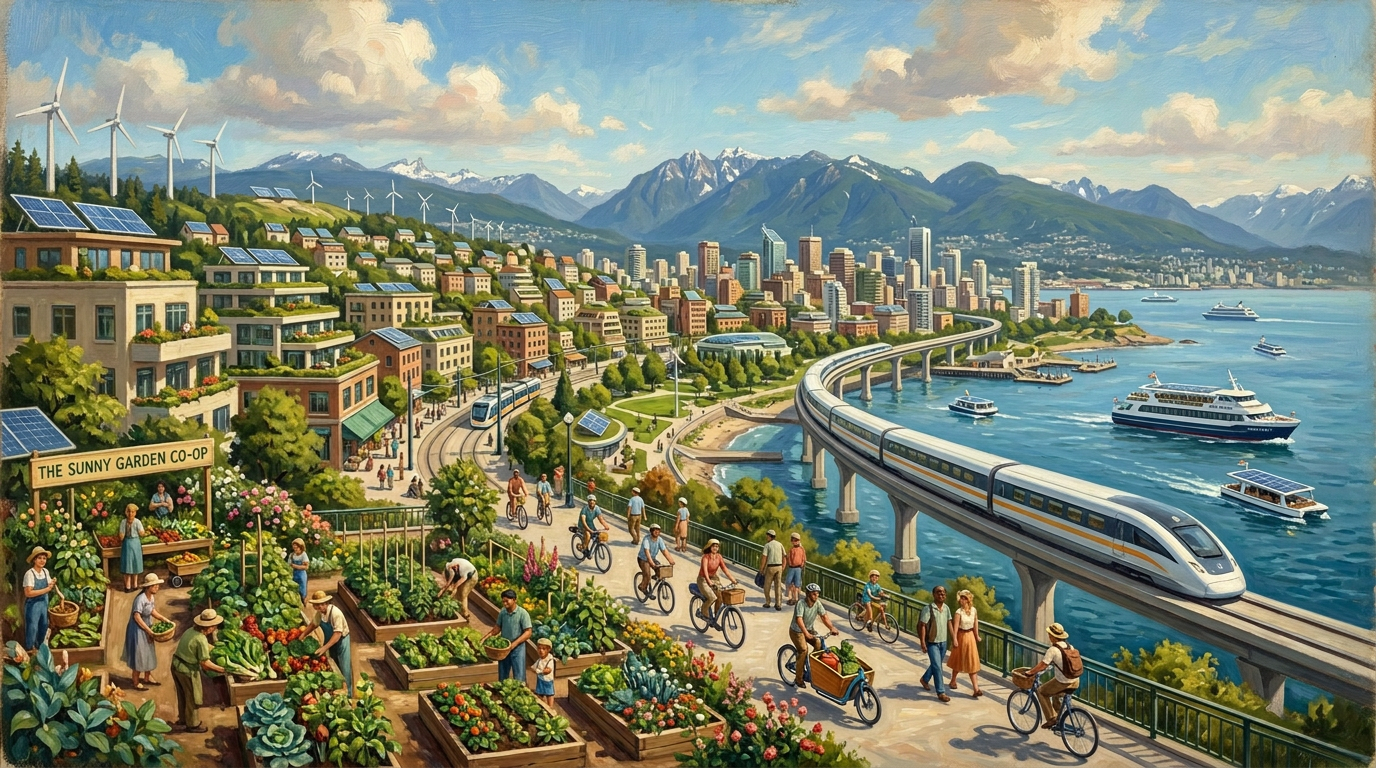
A green economy is one that grows through low-carbon, resource-efficient activity, such as renewable energy, building retrofits, public transit and clean manufacturing, while creating jobs and cutting pollution. It should also be socially inclusive, meaning the benefits reach ordinary people, and everyone has a fair shot at earning a living wage. This doesn’t mean handing them one – it means making sure the starting blocks give everyone a fair shot. From early childhood education to affordable housing to a minimum wage that works both for workers and the businesses who employ them.
It’s realistic if we make it happen. It does require a mentality shift – which could begin with something as simple as diverting public assistance from fossil fuels into clean tech, to start.
It’s a lofty goal, but it’s the goal that Sustainable Steps is founded upon, and takes inspiration from the United Nations Sustainable Development Goals.
OK, so this weekend’s election. Isn’t the Green Party too fringe to take seriously?
Not really. Not anymore. The Green Party of BC was founded in 1983, the year of Cabbage Patch Dolls and Michael Jackson’s debut of the moonwalk.
They’ve come a long way from the cabbage patch over 43 years. They’re no longer singing Kumbaya and planting trees. Not that they ever were – Federal Green leader Elizabeth May has long described the party as left on the environment and right on fiscal restraint – but they had that reputation, and they were underorganized and more of a protest vote at first.
Now, though? Today’s BC Greens have a costed, full-spectrum platform on everything from health care to the housing crisis. I don’t love how heavily they want to tax the ultra wealthy or mega corporations (they’ve drifted further left in recent years, which is a balance that I hope shifts back), but I do love how fiercely they want to create an environment for small and medium sized businesses to thrive – which gives communities character and promotes a strong local economy. No party is perfect, but for me, they’re a lot more perfect than most.
They still don’t have the numbers to form government, but every vote they get – even in ridings where they have zero shot at victory – will increase the overall voter share, which will speak loud and clear to the parties who do control the legislature about the sustainability values their voters increasingly hold.
Every Green vote helps bring the radical into the mainstream – which is where it will start to shape real public policy.
Why waste the vote on a candidate who won’t win?
In two ridings, the Greens have a real shot.
My riding, West Vancouver – Sea to Sky, is one of them. My daughter and I are volunteering wherever we can to help Jeremy Valeriote keep his seat against the blue tide that seems to be sweeping the province. He’s an engineer, he’s pragmatic, and he’s one of the old school Greens in that he’s neither left nor right. It’s super cool to see the work he’s been doing across party lines to get real stuff done for our riding.
The second riding is Saanich North and the Islands, which was Green prior to the election, and the party leader, Emily Lowan, has a good chance to win it now.
Two other ridings are interesting: Victoria-Beacon Hill and Vancouver-Strathcona. The Conservatives have removed candidates in both over social media posts. The names remain on the ballot because the withdrawal deadline had passed, so they’re not totally out of the running. But they’re no longer serious candidates. These are both stronghold NDP ridings, where many Greens hold their nose and vote “strategically” to prevent a Conservative win. But if you live in one of these ridings and want to send Eby a message that you’re not happy with his work (or this snap election that he called in the middle of a municipal election), it’s a great time to log your vote for the Greens.
In all other ridings, your Green vote still carries weight. Call it a protest vote if you like – my first Green vote was. But every Green vote increases the voter share, which gets them taken more seriously both in elections to come, and by the people in power who — despite appearances to the contrary — are trying to keep their fingers on the pulse of what voters want.
Use your vote to tell them what you really want.
It’s not even really that radical.
Scientists are on this – they have been for several decades. A few countries are nearly there with their energy grids.
Nearly 60% of Denmark’s power comes from wind. Uruguay took wind from 1% to 34% of its electricity in just five years, and fossil fuels fell to less than 3% of its power in 2025. Costa Rica generated roughly 98.6% of its electricity from renewable sources in 2025. The IPCC – the United Nations body that assesses the science related to climate change – estimates that about half of global emissions could be cut by 2030 with fairly low-cost measures available now, with wind and solar among the biggest.
Here in BC, over 90% of our electricity already comes from renewable sources.
So why fund fossil fuels or clean tech, if we’re at 90% renewables already?
Because electricity is only about 17% – roughly one-sixth – of the energy we use in BC, according to a 2025 Metro Vancouver committee report. Most of the rest, from our cars to our furnaces, still burns fossil fuels. Switching over will take a lot more clean power – which is where the Greens propose our public money is better spent.
The other case for LNG is that it’s an export business, and Asia and Europe want it. Fine. But if it’s that good a business, it shouldn’t need public discounts to get built.
Voting NDP or Conservative are flip sides of the same coin – both are bets for a different shade of the status quo. Voting Green might feel radical the first time you do it – but I see it as the smartest math there is, for both our economy and our quality of life for generations to come.
What kind of clean power do they want to explore?
The possibilities are amazing.
Along our own coastline, waves and tides carry enormous steady energy, and engineers are learning how to harness it. Deep underground, geothermal heat runs day and night. These technologies are young, and some are still being proven, but so were wind and solar not long ago, and they’ve already changed what we thought was possible. The more we invest in them now, instead of propping up what’s winding down, the sooner they can power the world our kids will inherit.
Think of it as medicare for the planet: a change we can all benefit from.
Final voting day is October 24, 2026.


Join the conversation