by Robin Spano
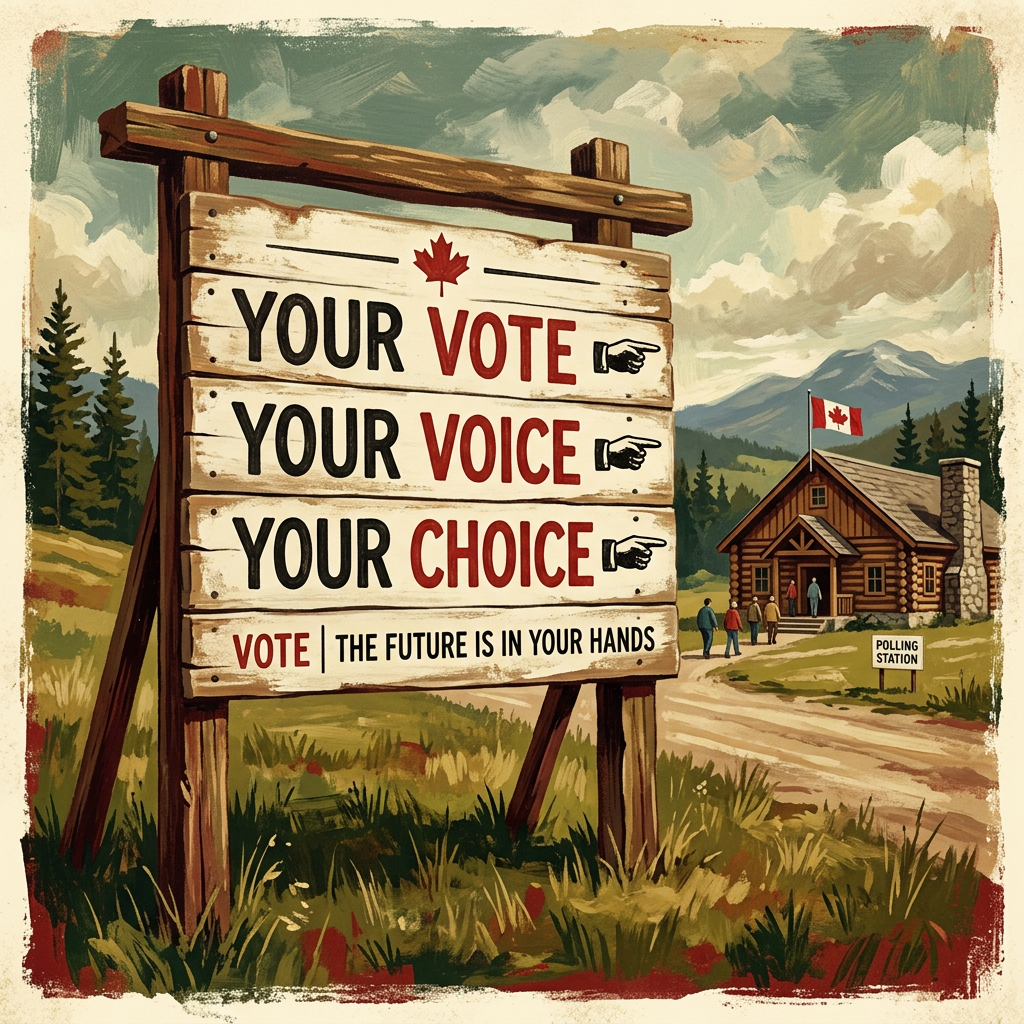
It’s by-election season in Canada. On August 31, 2026, three federal ridings – one each in British Columbia, Ontario, and Quebec – will elect new MPs to send to Ottawa.
This won’t change the shape of the government. The Liberals are in power now, and they’ll be in power no matter the outcome of these by-elections. If they win one, two, or three seats, they keep their majority. Lose them all (extremely unlikely since two out of three are considered Liberal strongholds) and they’ll still form government – but with a slim minority.
But it’s precisely because we can count on nothing big changing that we have a strange and wonderful opportunity: We can throw strategic voting out the window and use this space to ask for a few key tweaks.
What should we ask for?
That depends where you think the balance needs adjusting.
My husband sees the economy as Problem Number One. He thinks the Conservatives would make better fiscal policy, so he would vote Conservative if we lived in a by-election riding. (We don’t.)
My parents also value fiscal responsibility, but they see Mark Carney – with his history of guiding both Canada and the UK through separate economic crises when he led their national banks – as having the edge on this. They also love his sustainability values. In their riding’s recent by-election, they voted Liberal. (They had a great Liberal candidate and I would have probably done the same.)
But this by-election comes in the heart of the worst forest fire season I can remember. The skies have been smoky across most of the country for most of the summer. People are losing homes, crops, businesses – and lives. On our family road trip to a ranch in the BC interior, I packed an air purifier in a suitcase so we could breathe clean air while sleeping. It’s pretty clear to most of us (civilians and scientists alike) that these fires are getting worse each year, and are fueled by the earth’s rising temperature. And the Liberal government has been heavily investing in fossil fuel infrastructure.
If I lived in a by-election riding right now, I would use my vote to ask the government to reassess that investment. I’d make that ask that by voting Green.
Why Green, and not the others?
The Green Party’s entire ethos is devoted to integrating fiscal, social, and environmental sustainabilty in a workable and science-backed way.
Mike Morrice, former Kitchener Centre MP and current Deputy Leader of the federal Green Party, said in his COP27 writeup: “We must also phase out fossil fuels to reduce our climate impact, given it’s the combustion of fossil fuels that causes this crisis. In Canada, we must avoid burning 83% of our known fossil fuel reserves, if we are to do our part in ensuring even a 50% chance of avoiding the worst effects of the climate crisis.”
Jeremy Valeriote, the Green MLA (provincial) in my riding, spoke to the Lions Bay Watershed with a call for his colleagues to “wake up,” saying, “BC is facing a new, perennial emergency. ‘Fire weather’ due to our changing climate is responsible for uncontrollable wildfires, enormous costs, and immense suffering.
“BC’s (and Canada’s) government has a choice: join the many countries around the world who are reducing carbon pollution, and stop expanding fossil fuel production, OR continue to add fuel to the fires.
“The risks posed by wildfires demand that our leaders wake up and act like we’re in an emergency. The costs of inaction will far outweigh any benefits we get from subsidizing LNG or building pipelines.”
Shelley Luce, the Green candidate in the North Vancouver-Capilano by-election, has also criticized the federal government for “giving billions in tax breaks and subsidies to the fossil fuel industry” while housing and affordable child care remain underfunded.
Mark Carney’s book, Value(s), illustrates how deeply he too understands that economic and environmental interests are necessary partners in creating a world that works. But I fear that the situation he’s stepped into makes it impossible for him to stay true to all of his value(s) at once.
What he stepped into is pretty wild.
The United States, once our trusted friend, has turned into an economic frenemy who might or might not be trying to steal our husband and move into our home.
The cost of living — aka the affordability crisis — is at an unsustainable peak. Grocery prices are nuts. I spent $9 on a can of chili at Choices the other day. That was a one-off decision I could afford to make, but it felt like a bit of a joke to pay so much for a can of beans. And gas prices? Wow.
It’s a super strange situation that requires a delicate balancing act on our government’s part. And for the most part, I think Mark Carney has been balancing brilliantly.
His “middle powers” speech in Davos was inspired – inspiring – amazing. He took us at a serious low point (there was actual talk of Trump invading, which may or may not have been rhetoric but it was unsettling either way), and he made us feel like Canada was in a power position. Since then, he’s gone around the world striking mutually beneficial trade deals with other countries that will boost our economy for years to come.
But he’s also been investing a lot of money in the fossil fuel industry.
Wait – are we actually pouring new public money into the dying fossil fuel industry?
Sadly, yes. In many shapes and sizes.
According to CBC News, the Carney government introduced a new tax benefit for oil extraction and brought back an old one for natural gas, allowing companies to claim accelerated depreciation on their assets for a lower tax bill. The tax break for LNG companies will cost the government $362 million over five years.
Carney suspended the federal Fuel Excise Tax on gasoline and diesel, which Environmental Defence characterizes as a $2.4 billion fossil fuel subsidy.
The federal government also quietly agreed to cover fees for a Norwegian oil company for a project off of Newfoundland and Labrador – to the possible tune of $1 billion.
And more.
But isn’t the world on fire because of fossil fuels?
Maybe that’s a bit dramatic. But yes: fossil fuels release greenhouse gases that contribute big time to global warming, which most scientists credit with the increasing droughts and heat and forest fires. So cutting back on fossil fuels would be a very smart move to help mitigate the fires.
But the economy has been really rough on a lot of people. Food, gas, rent, mortgage payments – not to mention the cost of home insurance because of increased natural disaster risk (!) – is stretching household budgets so thin that many of us are being forced to make changes to our lifestyles. It’s true that our current lifestyles are generally too consumeristic (and contributing to the world heating up), so living with less is an ideal we would all do well to work toward. But “less” thrust upon us involuntarily and unevenly is a stress that’s hard to bear. I’d much rather thrift because it’s fun and eco-friendly than because I can’t afford to buy my kid new clothes while her friends are still buying up the entire new season of Zara. No one wants to be forced to give up travel and restaurant meals if their friends don’t have to yet. It’s unsettling, makes it feel like the ground is shifting under our feet. I fully understand why many people don’t have room to care about any clean tech future down the road – they need food on their table today.
So it’s natural — empathetic, even — for the government to reach for a patch to get its people through the stress.
And early reports are showing real signs of life for an economic rebound in Canada.
OK. Makes sense. They’re putting food on tables first, and then they’ll fix the planet.
Except it doesn’t work like that. If our economy is stronger because of increased oil and gas production, it’s a sugar high – an investment in an industry that’s on its way out if we want to stick around on this planet much longer, not a solid investment in the clean energy that will take us into the future.
Is there a long game? I sure hope so.
With most politicians I would have already abandoned hope, but Mark Carney has written at length about how the economy and the climate are tangled together — that markets have spent decades ignoring the real cost of carbon, and that getting climate risk onto the same balance sheets banks and investors already care about is how you actually get money moving toward solutions, instead of just hoping people do the right thing. As the UN’s climate finance envoy, he helped build the rules that push banks and investors to factor climate risk into their decisions, and he co-founded a global alliance of banks and investors — managing over $130 trillion between them — who committed to putting their money behind the shift to a low-carbon economy. He also spent years at Brookfield Asset Management, one of the world’s biggest investment firms, specifically leading their push into “transition investing” — funding the infrastructure, like renewable power and clean industry, that a lower-carbon economy actually needs to run on.
I feel like we finally have a guy in office who’s there to do a job (not land a job), who’s really rolling up his sleeves and applying his mind to finding creative solutions to complex problems, and who needs a bit of help from voters to remind him where the balance needs adjusting.
What can a Green voice do?
It can remind Mark Carney that Canadian voters care about our long term economy as much as the short term.
Elizabeth May has shown us that a lone MP from a smaller party can do real things: ask sharper questions in Question Period, force a topic onto the record that the bigger parties would rather leave alone, build relationships across party lines, and give a national platform to issues that otherwise get steamrolled in the scramble.
And even if the Greens don’t win a new seat this time around, each vote for them counts. Vote totals get read by party strategists, media, and the candidates themselves. A strong showing for a long-shot candidate tells every party watching that there’s real appetite for what that candidate stands for, even in a seat they don’t win (this time around).
We’re not electing a whole new government. We’re asking one of the smartest leaders Canada has ever seen to tweak his game in a direction we know he can sympathize with.
The Ridings
In North Vancouver—Capilano (B.C.), the Liberals are running Braeden Caley, Mark Carney’s former deputy chief of staff; the Conservatives have Stephen Curran, a lawyer making his second run at the seat; the NDP’s candidate is longtime local organizer Stephen Tweedale; and the Green candidate is Shelley Luce, an environmental scientist.
In Beaches—East York (Ontario), the Liberals are running Tanveer Shahnawaz, a former staffer to outgoing MP Nate Erskine-Smith; the Conservatives have Jim Sybros; the NDP’s Shannon Devine is a longtime labour and social-justice organizer making a repeat run; and the Green Party’s candidate is Bruce Livesey, a former investigative journalist and TTC bus driver.
In Chicoutimi—Le Fjord (Quebec) — the closest three-way race of the bunch, between the Liberals, Conservatives and Bloc Québécois — the Liberals are running dairy farmer and agricultural leader Daniel Gobeil, while the NDP has acclaimed Raphaël Émond, a Chicoutimi native making his second run for the party. There’s no Green running in this one. If I lived here, I would meet all of the other candidates and make a decision based on the voice I think they will bring to the conversation in Ottawa.
So basically…
…this is about as low-stakes-high-impact as voting gets. You’re not choosing a government, and you’re not risking the wrong party ending up with the balance of power. You’re telling the current government what you’d like to see them do differently – in a way they can actually hear.
That’s worth a trip to the ballot box.


Join the conversation