There’s a reason that the movement to solve the climate crisis is called “green.” When we plant trees and other greenery, the leaves absorb carbon dioxide from the air during photosynthesis. Every leaf on every plant helps reduce greenhouse gases in the atmosphere, which is a big win for fighting climate change.
Plants also help cool the air, provide habitats for wildlife, and foster biodiversity. So, whether it’s indoor plants purifying the air or native outdoor species supporting local ecosystems, everything you plant and grow is a sustainable step for the planet.
Outdoor Planting
Outside, the best thing you can do for the environment is to plant native species — either as your entire garden, or as selections throughout it. Most insects will ignore foreign plants — they don’t consider them a food source. Native plants, on the other hand, attract insects as pollinators. Insects attract birds who like to eat them. Native plants are also (in general) much hardier — they’ve adapted to thrive in the conditions they’re native to.
Definitely have fun with plants from all around the world, if you enjoy it. It’s a wonderful way to be creative in an eco-friendly way. But including even one or two native plants in your garden will help the birds, bees, and butterflies in your neighborhood.
The David Suzuki Foundation runs a wonderful program called The Butterflyway Project, where local communities can join forces to create pollinator pathways in urban areas across Canada. Check out their interactive map to see if your community is already involved. If so, grab some seeds and a sign and get on board! If not, consider becoming a Ranger for your neighborhood in 2025 — it’s a great way to start the conversation with neighbors about climate change, and to take a sustainable step for the planet.
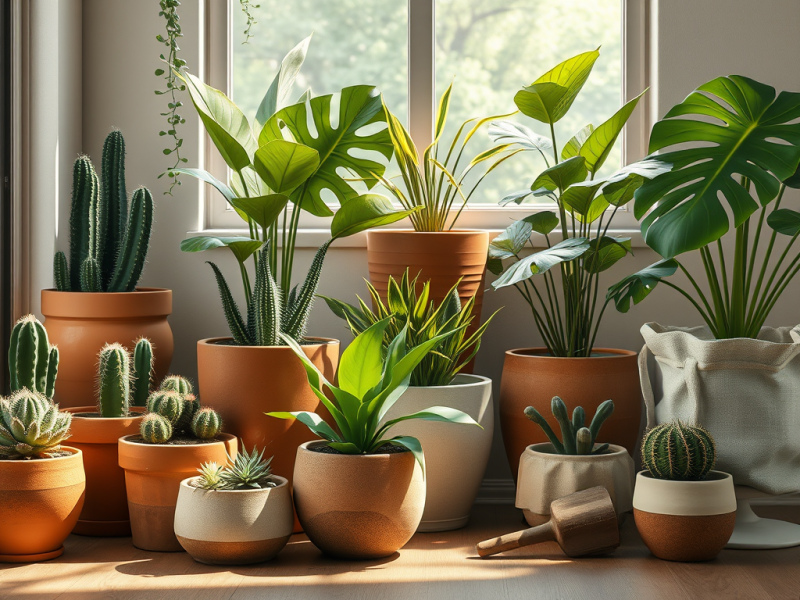
Indoor Planting
A year and a half ago, my 9-year-old daughter bought a Venus fly trap with her allowance money, and she’s been jungling up our house ever since. I couldn’t help get caught up in the hobby, and now it’s a passion we share.
Our favorite place to shop in person is a Vancouver store called Frondly. They’re sell healthy, interesting plants, sustainably made pots at good prices, and high quality, nature-based soil and nutrients. Their website has a comprehensive care guide for plants that we use whenever we have questions.
We love everything we’ve ever bought from Mossify — a sustainable Canadian brand that invented the bendable moss pole. (Which we have in our monsteras, umbrella tree, and philodendron — basically anything with aerial roots.)
A year and a half in, we JUST learned how to water, from this groovy post from JOMO.
We explore earth-friendly pot choices in our post: Choosing sustainable pots for indoor gardening.
We have several propagation experiments on the go. We use the jelly from inside our aloe plant as a rooting hormone, along with a sprinkle of cinnamon. Whether that’s helping us or not, who knows? But new plants are growing, and we’re not using chemicals. So far, we’ve had the most success with peace lilies, different kinds of peperomia, and bunny ears cacti. (But we’re game to keep trying the harder stuff too.)
Composting
We have JUST started to make our own compost. We’re not at a level to give any tips yet (I’ll for sure update if and when we get there) but we are so far quite happy with the purchase of our Canadian-made composter that was manufactured with post-consumer recycled plastic. It’s durable — survived a bear attack on its third night out, including a tumble down a steep rocky hill — though we’ve since moved it to an enclosed deck. Our friend brought some worms over to help speed up the process — we’re watching and waiting for the first barrel to be ready.
When we’ve filled both barrels of this one, our plan is to also purchase the worm composter from the same company. Friends swear by the worm tea it produces as one of the best fertilizers out there.
More soon! We’re learning as we go and will share any useful things we learn.


 Sustainable Steps
Leave a comment