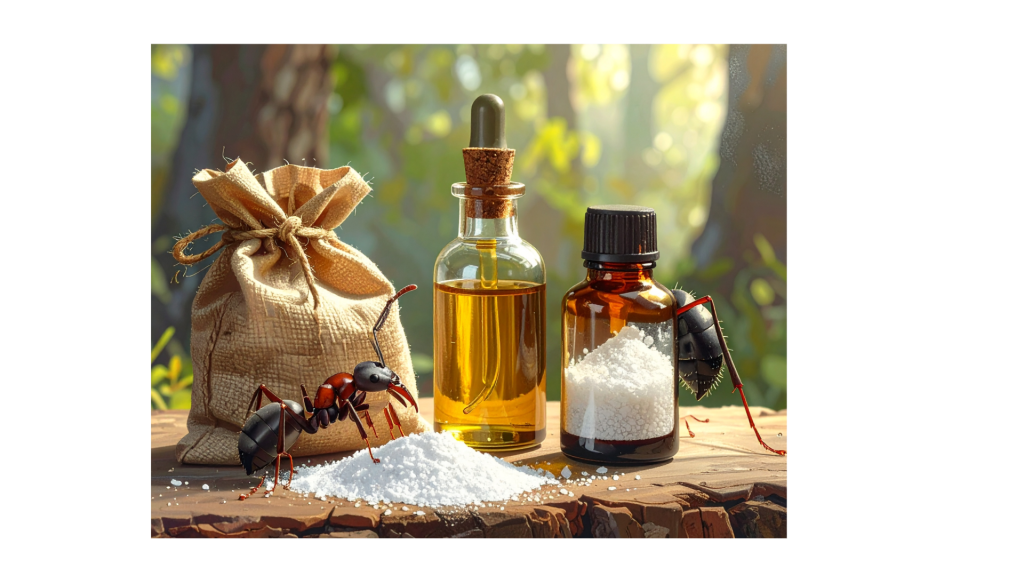

I live in a forest. Every year, when it starts to get warmer outside (yes, that means February these days!), we start to see carpenter ants everywhere in our house. The bathroom. The kitchen. I even had to ditch my last batch of homemade kombucha when they crawled into the teapot to soak up some lingering sugar.
Unlike termites, carpenter ants don’t eat wood, but they do excavate it to create their nests, which can lead to structural damage over time. So I want them gone.
Last year (and every year before that), we’ve gone the traditional route: called in a pest control guy and asked for the most minimally invasive solution to effectively get rid of the problem. It’s worked well — the bait he left us with last year was (he said) mild enough that it would be safe for our free-roaming bearded dragon to eat an ant who had eaten it. And it worked (for the rest of that ant season).
But this year, I made a deal with my husband to let me try some natural solutions first. So I scoured the Internet and found these ideas consistent among natural ant control options:
1. Vinegar
Create a mixture of equal parts vinegar and water, then spray it in areas you’ve spotted carpenter ants. Not only does it clean surfaces, but it also masks the scent trails that ants use to navigate.
It’s not an option in my house – my husband loathes the smell of vinegar and would probably rather live with ants. And it also won’t kill them – it will just make them move away from wherever I’ve sprayed vinegar. And since vinegar evaporates fast, they’ll be back once the scent is gone.
2. Essential Oils
Peppermint, tea tree, and citrus oils are particularly repulsive aromas for these ants. Mix a few drops of your chosen scent with water in a spray bottle and apply it to areas where you suspect ant activity. The strong scent will deter them and leave your home smelling fresh. Again, this isn’t a death solution. But since these are scents my family will enjoy, I’ll try it. The theory is that it will act as a deterrent for them to come into the spaces that smell nice (to you) – and if you make sure to include their main food sources (kitchen and pantry), they might just seek out a different house to excavate the wooden beams. (I’ll let my neighbors know they’re coming.)
3. Borax and Sugar Bait
I’m including this because EVERY single source I look at for natural ant removal mentions borax. Mix equal parts borax and sugar with water to create a bait. Place it in shallow dishes near areas where you’ve seen ants. The sugar lures the ants in, and the borax works as a poison that they carry back to their nest.
But guess what? This is NOT a natural product. It will kill the ants, sure, but it’s also classified as a skin and eye irritant, and prolonged exposure can lead to more serious health issues, like reproductive toxicity and potential endocrine disruption. Children and pets are particularly vulnerable, as ingestion of borax can cause nausea, vomiting, and even more severe gastrointestinal problems. Environmentally, borax can contaminate soil and waterways, affecting plant life and aquatic ecosystems. Its presence can disrupt the balance of local wildlife, harming beneficial organisms while creating toxic conditions for the surrounding flora and fauna.
So yeah. Dead ants. But not what this blog or my life goals are all about. I’m skipping the borax.
4. Diatomaceous Earth
Guys, I think we have a winner. Food-grade diatomaceous earth is safe for humans and pets to ingest, but when ants come into contact with it, it damages their exoskeleton, eventually leading to dehydration.
Two glitches: It’s not safe to inhale (for humans or bearded dragons). So when you apply it, use a mask — and leave the powder where you don’t think someone’s going to be sniffing around it.
If you don’t have small kids or roaming pets, you can safely sprinkle some around wherever you suspect ants are getting into YOUR part of the house.
BUT, since our beardie roams the same floors where we want to kill the ants, I’m going to repurpose some old containers to lure the ants in with a sugar/diatomaceous earth mixture, with a tiny opening that Thunder can’t crawl into – only ants can.
This won’t work as fast as Borax and other chemical solutions, but it makes me much happier to try this option first.
Conclusion
My sustainable step for the week is to wage war against carpenter ants, using natural ingredients as my weapons. I will update once I know how effective they are (or aren’t).
Let me know if you have other solutions that you’ve tried!

 Sustainable Steps
Leave a comment